
3D Curved vs 358 Anti-Climb Fence: Which Defends Better?
3D Curved vs. 358 Anti-Climb Fence: Which Welded Mesh Defends Better?
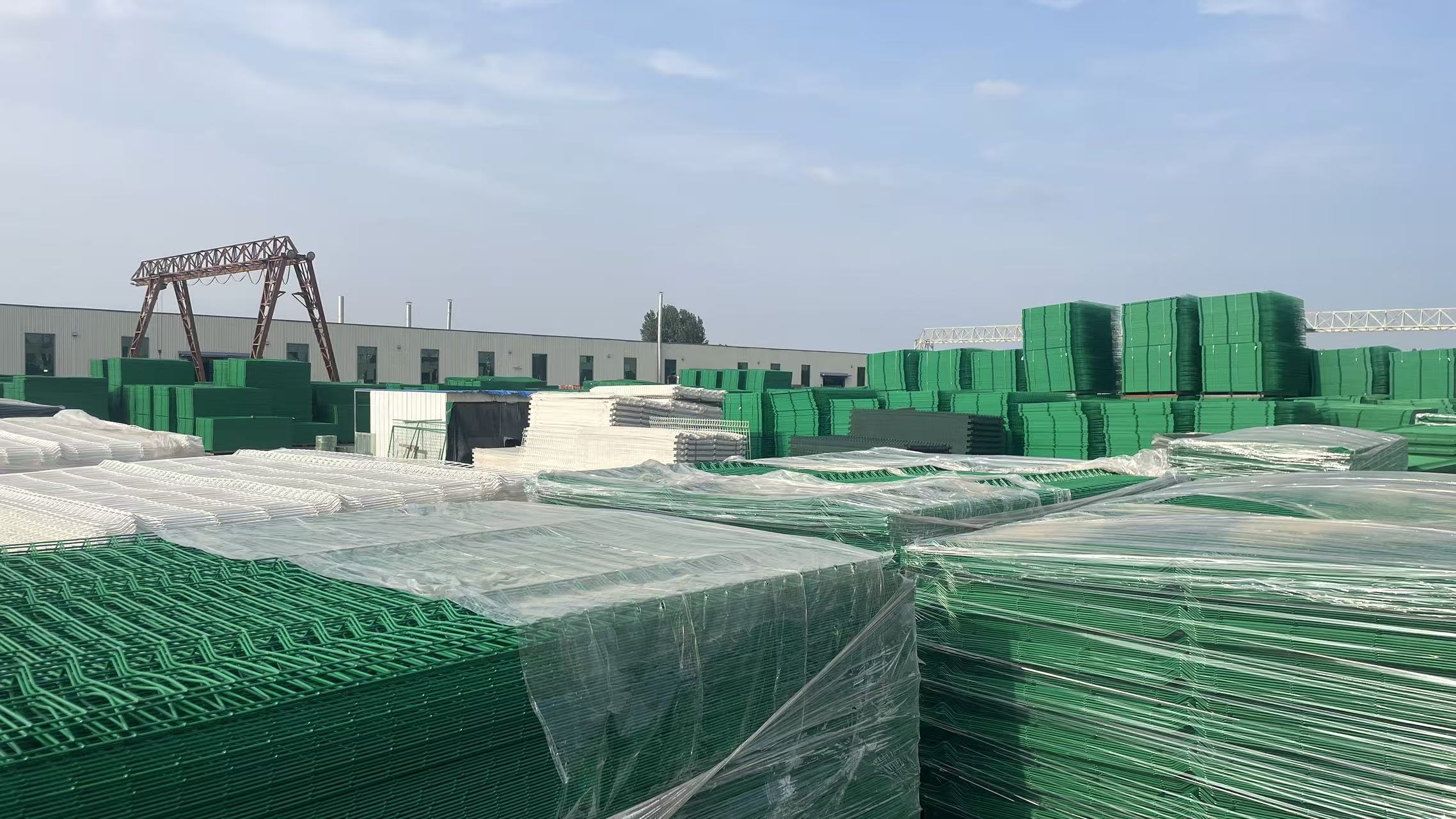
Cover: welded mesh fence panels from one manufacturing family — 3D curved for public-facing perimeters, 358 anti-climb for high-risk zones.
Two welded mesh panels can look almost identical in a quotation sheet and behave completely differently on a real perimeter. A 3D curved fence is chosen for how it reads to residents, planners and visitors. A 358 anti-climb fence is chosen for what it does to someone trying to climb over it, cut through it or reach past it. Buyers who have already passed the research stage face one practical question: which of the two defends better — and better against what?
The direct answer: 358 anti-climb defends better where intrusion is a real, repeated risk; 3D curved defends better where a site must stay open, attractive and socially acceptable while still blocking casual access. Both belong to the same welded mesh family, share the same welding and coating logic, and — when manufactured to a controlled specification — are designed around long service life with zero maintenance inside the first ten years. This guide compares them as what they are: two architectures of the same welded mesh fence, aimed at two different threat profiles, and intended to be ordered, inspected and re-ordered over a multi-year project cycle.
Problem Definition: The Trade-Off Buyers Usually Get Wrong
The 3D-versus-358 decision fails in one of three predictable ways, and all three are specification errors rather than manufacturing errors.
Failure mode 1 — over-specification. A residential boundary, a park edge or a municipal walkway is fitted with high-security panels because security is the only criterion on the list. The perimeter becomes visually heavy, planning discussions become harder, and the extra defence capability is never used. The site pays for protection it does not need.
Failure mode 2 — under-specification. A logistics yard, railway corridor or airport boundary is fitted with a visually pleasant curved panel because it matched the site aesthetic. If the panel offers easy hand- and foot-holds, or if hand tools can cut the wire, the fence delays an intruder by seconds rather than minutes, and the replacement cost is paid repeatedly.
Failure mode 3 — specification drift. The right panel architecture is chosen, but the wire diameter, mesh aperture or coating differs between the first delivery and the third. Panels that were compliant on the sample are no longer interchangeable on site, gates no longer align, and corrosion appears on the batch that was produced in a hurry.
The decision rule that removes all three failure modes is simple: match the panel architecture to the threat profile first, then qualify the supplier on repeatability second. Price comparison comes after both.
Industry Background: Why Panel Choice Is Now a Long-Term Decision
Welded mesh fencing is no longer a commodity purchase decided on the lowest linear-metre price. The global welded wire mesh fence market was valued at USD 7.04 billion in 2025 and is projected to reach USD 11.72 billion by 2034, according to Dataintelo. The wider fencing market was estimated at USD 33.8 billion in 2025 by Grand View Research, with metal taking the largest material share at 53%. Asia Pacific held a 38.5% revenue share of the welded wire mesh fence market in 2025, driven largely by infrastructure programmes in China and India.
Two standards frame the technical conversation for schools, parks, industrial sites and high-security perimeters. EN 10223-7:2012 specifies requirements for steel wire welded panels for fencing. ASTM F2453/F2453M-14 covers welded wire mesh fence fabric with metallic or polymer coatings for high-security applications. Both are referenced when a buyer needs a defensible specification rather than a visual preference.
Supplier behaviour is also shifting toward integration. Betafence Group expanded its perimeter security portfolio in February 2024 with new-generation welded mesh systems combining intrusion detection and solar surveillance. The recognised global players in security fencing — Betafence, Bekaert, Ameristar Perimeter Security and Jacksons Fencing — increasingly position the panel as one element inside a detection and response system. For buyers, that changes the brief: the fence panel must be repeatable, dimensionally stable and compatible with clamps, fixings and sensors over many years, because it will be supported by electronics rather than replaced.
Industry application data shows where each architecture earns its place: welded mesh fences are preferred for critical infrastructure such as railways and schools because rigid frame panels and anti-climb characteristics reduce cable theft and deter unauthorised access.
Detailed Solution: How Each Panel Actually Defends
Anping Dengfeng Wire Mesh Products Co., Ltd. (Dengfeng) is a welded mesh manufacturer founded in 2008 in Anping County, Hebei Province, China, producing welded mesh rolls and panels, 358 security fences, BRC and roll-top fences, double-wire panels, chain link and temporary fences, and exporting roughly 80% of output to Europe, Saudi Arabia, the Middle East, the UAE and the United States. Its 3D curved and 358 anti-climb panels are produced on the same welding and coating line, which is why the comparison below starts with what the two products share.
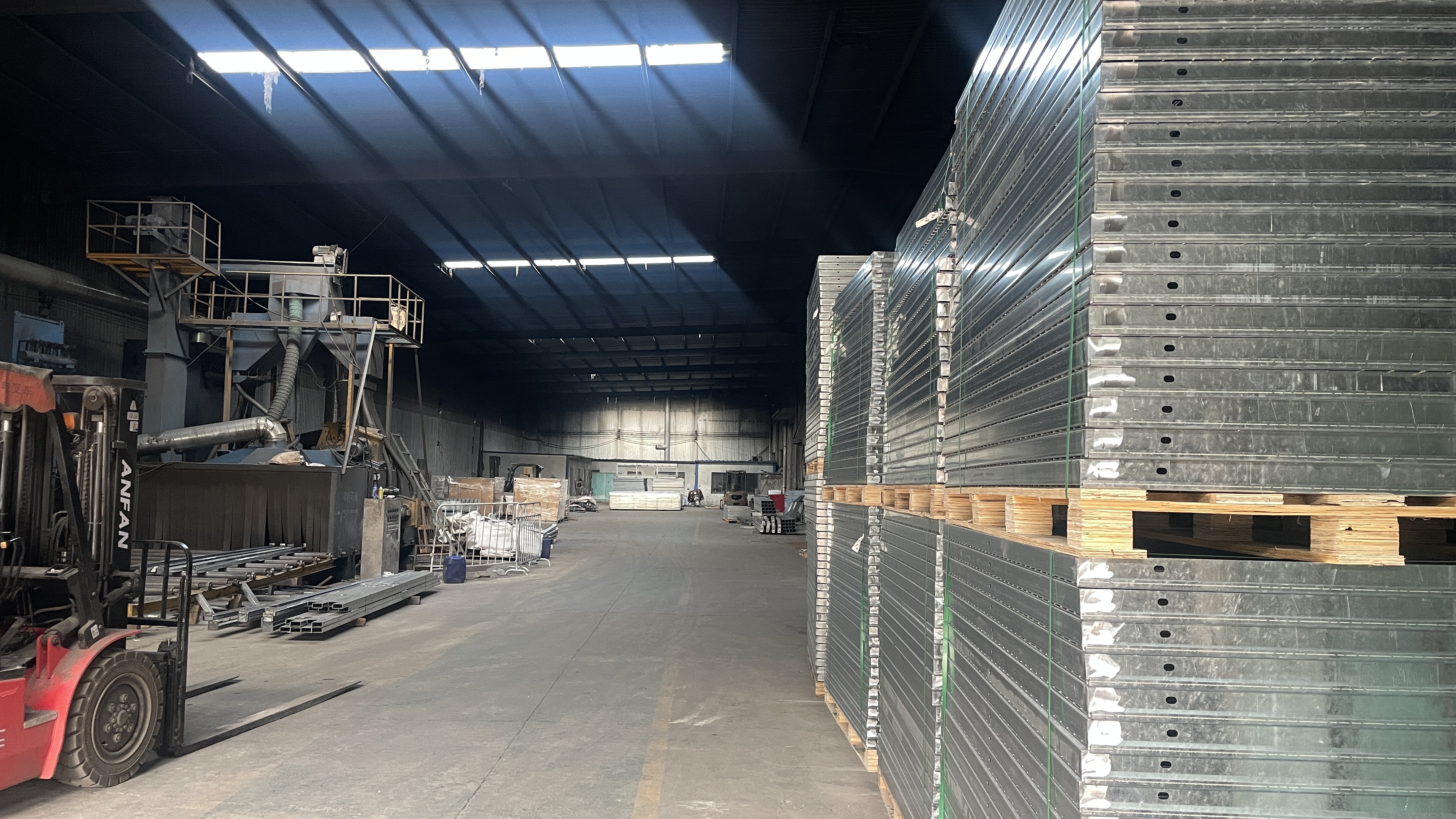
Panel inspection: wire, weld and coating are checked before shipment on both 3D curved and 358 anti-climb orders.
3D Curved Welded Mesh Panels: Rigidity Through Form
A 3D curved welded mesh panel gains its stiffness from the horizontal bends formed into the panel body rather than from a heavy external frame. The curved profile increases rigidity, keeps the mesh under tension, and gives the perimeter a lighter, more architectural appearance. The result is a welded mesh fence that reads as a designed boundary rather than a barrier.
This is why 3D curved panels are the natural choice for residential properties, parks, sports fields, school grounds and municipal or real-estate boundaries: they define space, resist casual pressure and vandalism, and remain acceptable to the people who use the site every day. Their defence logic is deterrence plus containment, not maximum penetration resistance.
358 Anti-Climb Welded Mesh Panels: Defence Through Geometry
The 358 anti-climb panel is built around a tight, small-aperture mesh combined with a heavy wire gauge. The aperture is deliberately too small for a hand or foot to find purchase and too narrow for common hand tools to be inserted and levered. The wire is heavy enough that cutting requires time, noise and multiple tools — which is exactly the point for high-risk zones such as airport perimeters, correctional boundaries and critical infrastructure.
358 panels are normally installed with security clamp bars and tamper-resistant fixings so that the panel cannot be unbolted from the post at leisure. Compared with 3D curved panels, the visual result is denser and more closed, which is acceptable in an airport or utility compound and rarely acceptable on a housing frontage.
What Both Panels Share: One Welded Mesh Family
The comparison is not between a strong product and a weak product. Both are welded mesh fence panels with welded intersections and rigid frame construction, which is why welded mesh fencing is preferred for critical infrastructure in the first place.
Welding is completed by robotic welding. Manual inspection is conducted throughout polishing, pickling and powder coating procedures. Surface treatment consists of hot-dip galvanizing followed by powder coating, so the panel is protected first by a metallurgically bonded zinc layer and then by a polymer barrier against abrasion and UV exposure.
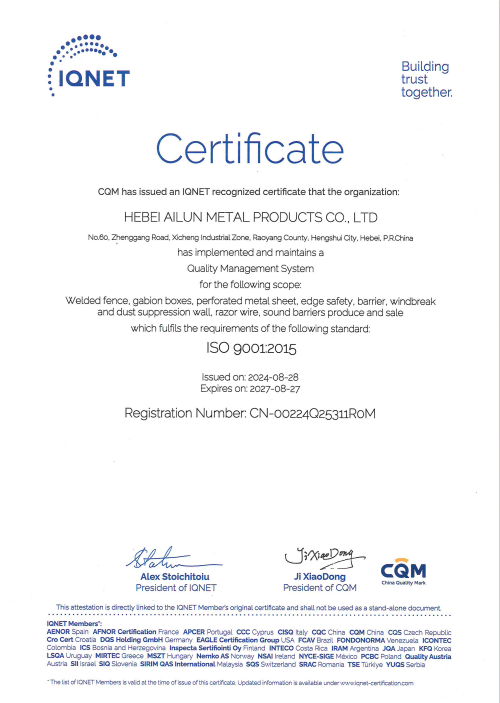
Manufacturing technology behind the welded mesh fence family is covered by utility model patents.
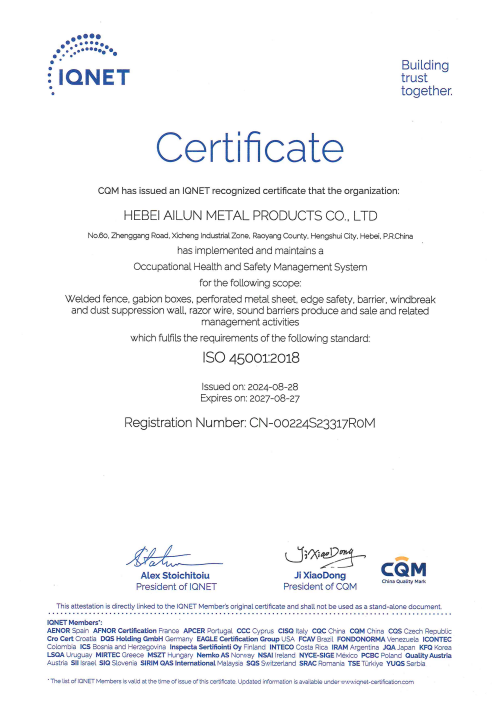
The two documented long-term risks for welded mesh fence panels are corrosion damage and structural deformation. Both are addressed at the production stage: hot-dip galvanizing and powder coating for corrosion, and a thickened wire structure for deformation resistance. These controls are backed by 100% raw material inspection, a finished-product load test and full delivery inspection, supported by an ISO 9001 quality management system, ISO 14001 environmental management system and ISO 45001 occupational health and safety management system.
Dengfeng manufactures both panel types in a 70,000 m² facility with 80 employees, a 10-engineer R&D team, annual output of 5,000,000 m² and monthly capacity of 420,000 m². Minimum order quantity is 1 set, and typical production lead time is 15–30 days.
Comparison Table: 3D Curved vs. 358 Anti-Climb
| Decision dimension | 3D curved welded mesh panel | 358 anti-climb welded mesh panel |
|---|---|---|
| Product family | Welded mesh fence panel | Welded mesh fence panel |
| Defence mechanism | Rigidity and clean lines; deters casual access and casual damage | Tight small-aperture mesh on heavy wire; removes hand- and foot-holds and resists cutting |
| Visual impact | Open, architectural, suited to public-facing boundaries | Dense and closed, visibly a security installation |
| Typical sites | Residential properties, parks, schools, sports fields, municipal and real-estate boundaries | Airport and port perimeters, correctional and other high-risk zones, critical industrial compounds |
| Welding and coating | Robotic welding; hot-dip galvanizing + powder coating; manual inspection through polishing, pickling and coating | Robotic welding; hot-dip galvanizing + powder coating; manual inspection through polishing, pickling and coating |
| Documented ownership performance (welded mesh family) | Zero maintenance within 10 years | Zero maintenance within 10 years |
| Cost profile vs. ordinary cheap wire mesh fence | About 5% higher initial cost, about 40% lower replacement cost | About 5% higher initial cost, about 40% lower replacement cost |
| Applicable standard reference | EN 10223-7:2012; ASTM F2453/F2453M-14 where high-security specification is required | EN 10223-7:2012; ASTM F2453/F2453M-14 |
Wire diameter, mesh aperture and panel height are confirmed against the supplier technical sheet and the approved sample for each project; they are not treated as identical across suppliers.
Step-by-Step Breakdown: From Decision to Executed Order
Step 1 — Write the threat profile before the fence specification. List what the perimeter must resist: casual climbing, determined climbing, cut-through with hand tools, object throwing, vehicle impact, or cable theft. The 3D-versus-358 question answers itself once this list exists.
Step 2 — Select the panel architecture. Choose 3D curved where the site is public-facing and the risk is opportunistic; choose 358 anti-climb where intrusion is a credible, repeated threat and the visual result is not the priority. Mixed perimeters are common: 3D curved along a street frontage, 358 anti-climb along a storage yard or substation at the rear.
Step 3 — Confirm the compliance frame. For projects in Europe, EN 10223-7:2012 governs steel wire welded panels for fencing. For high-security applications, ASTM F2453/F2453M-14 covers welded wire mesh fence fabric with metallic or polymer coatings. Confirm which applies to your project before fixing the specification.
Step 4 — Lock the specification and the coating. Agree wire diameter, mesh aperture, panel height, post spacing, gate interfaces and coating build-up in writing. Surface treatment for both panel types is hot-dip galvanizing followed by powder coating, with a thickened wire structure specified where deformation risk is elevated.
Step 5 — Verify the manufacturing evidence, not the brochure. Ask how the welds are made (robotic welding), how the surface is controlled (manual inspection throughout polishing, pickling and powder coating), and what quality controls apply (100% raw material inspection, finished-product load test, full delivery inspection). Management system certificates — ISO 9001, ISO 14001, ISO 45001 — plus utility model patents and a product quality inspection test report give you something to file.
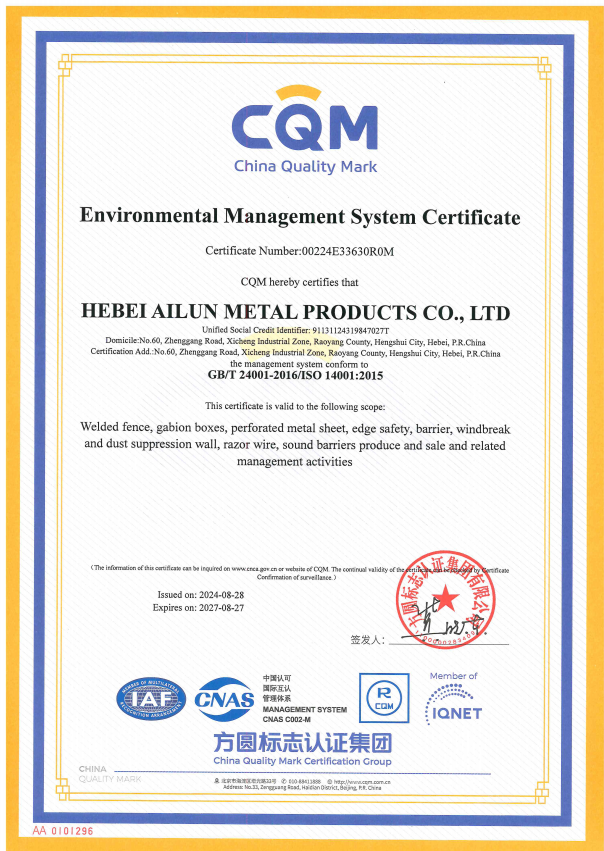
Compliance documentation available for tender files: management system certificates covering quality, environment and occupational health and safety.
Step 6 — Validate with a sample before volume. Minimum order quantity is 1 set, which makes physical validation practical. Acceptance criteria are pre-shipment full inspection, and a third-party test is acceptable if your client or insurer requires independent confirmation.
Step 7 — Execute the order against terms you can plan around. Typical production lead time is 15–30 days; monthly production capacity is 420,000 m², which matters when a multi-site rollout must be delivered in phases. Delivery terms are FOB Tianjin or CIF, and payment terms include L/C, T/T, D/P, Western Union, Paypal and Money Gram.
Step 8 — Install for defence, not just for alignment. Clamp bars, tamper-resistant fixings, ground clearance and gate interfaces determine whether a 358 panel performs as designed. Follow installation safety guidelines for panel handling and post setting, and document the as-built layout for future extensions.
Step 9 — Plan the repeat supply. Multi-site owners eventually re-order rather than re-tender. Keeping one approved specification and one supplier record prevents the specification drift that causes gates to misalign and panels to mismatch two years later.
Use Cases: Matching the Panel to the Site
Schools. Anti-climb behaviour matters, but so does appearance and safety. 3D curved welded mesh fence is the mainstream choice for school boundaries, with small-aperture panels used only where a specific intrusion risk has been identified.
Parks and sports fields. Open visibility and low maintenance dominate. 3D curved panels protect the perimeter without turning a public space into a compound.
Residential properties. Aesthetics and planning acceptance decide the specification; 3D curved panels are the standard answer, usually powder coated to match the development.
Industrial perimeters and utilities. Where theft, vandalism and unauthorised access are recurring, 358 anti-climb panels with security clamps provide the climbing and cut resistance that 3D curved panels are not designed to deliver.
Railways. Cable theft prevention is a recognised driver, and welded mesh fences with rigid frame panels and anti-climb characteristics are preferred along critical rail corridors.
Airports and ports. High-security zones use 358 anti-climb panels as the physical barrier layer, with clamps and fixings specified to resist disassembly.
Long-Term Ownership: What the Next Ten Years Cost
Panel architecture decides how well a perimeter defends. Ownership performance decides whether that decision was financially sound. For welded mesh fence panels manufactured to the specification described above, the documented position is a design life expectation of over ten years, with zero maintenance within the first ten years.
Compared with ordinary cheap wire mesh fencing, welded mesh fence panels of this construction carry roughly a 5% higher initial cost and roughly a 40% lower replacement cost, with a service life at least six years longer and better anti-corrosion and anti-climb performance. For a multi-site owner, the practical implication is fewer reactive purchases, fewer mismatched panels after repairs, and a perimeter that can be extended in later phases without re-specifying from zero.
FAQ: 3D Curved and 358 Anti-Climb Welded Mesh Fence
Which standards should a 3D curved or 358 anti-climb welded mesh fence comply with?
For European projects, EN 10223-7:2012 specifies requirements for steel wire welded panels for fencing, including panels used at schools, parks and industrial sites. For high-security applications, ASTM F2453/F2453M-14 covers welded wire mesh fence fabric with metallic or polymer coatings. The applicable standard depends on the destination market and the project brief, so it should be confirmed at specification stage rather than after delivery.
How can a buyer verify that a supplier can repeat the same 3D or 358 specification across orders?
Look for evidence of process control rather than promises. At Dengfeng, welding is completed by robotic welding and manual inspection is conducted throughout polishing, pickling and powder coating. Quality controls include 100% raw material inspection, finished-product load test and full delivery inspection, supported by ISO 9001, ISO 14001 and ISO 45001 certification, utility model patents and a product quality inspection test report. Monthly production capacity is 420,000 m², with an annual output of 5,000,000 m² from a 70,000 m² facility.
Is a 358 anti-climb panel worth the additional cost over a 3D curved panel?
It depends entirely on the threat profile. Where intrusion is unlikely and the boundary is public-facing, 3D curved delivers adequate protection with better visual acceptance. Where intrusion is credible — airports, ports, correctional and utility compounds — the cut resistance and absence of climbing holds on a 358 panel justify the specification. Across the welded mesh fence family, the documented cost position relative to ordinary cheap wire mesh fence is about 5% higher initial cost against about 40% lower replacement cost, with zero maintenance within 10 years.
Can I test a sample before committing to volume, and what are the acceptance criteria?
Yes. Minimum order quantity is 1 set, so a physical sample can be produced and evaluated before a larger order. Acceptance criteria are pre-shipment full inspection, and a third-party test is acceptable where the client or insurer requires independent verification. Typical production lead time is 15–30 days.
How do I qualify a long-term welded mesh fence supplier for school security projects?
Qualify on repeatability, documentation and delivery discipline rather than on unit price alone. For school security projects, that means one confirmed panel specification, a documented welding and coating process, compliance evidence for the destination market, a validated sample, and a supplier able to hold the same specification across phased rollouts and later repairs. Dengfeng has manufactured welded mesh fence since 2008 and exports to Europe, the Middle East and the United States; buyers can request a sample or a quotation, review the product brochure, or contact the team directly at sales@alunfence.com or via WhatsApp on +86 158-3395-6854.
Conclusion: Choose by Threat, Then Buy by Repeatability
Neither panel wins outright. 358 anti-climb defends better against a determined intruder: the tight aperture removes climbing holds and the heavy wire resists cutting, which is why it belongs on airport, port, correctional and critical infrastructure perimeters. 3D curved defends better against the real risks of a public site — casual access, vandalism and the steady pressure of daily use — while keeping the boundary visually acceptable at residential, municipal and school locations. Both come from the same welded mesh family, both rely on robotic welding, hot-dip galvanizing plus powder coating, and documented inspection, and both are engineered for long service with zero maintenance within the first ten years.
The defensible buying sequence is therefore: define the threat, choose the architecture, confirm the standard, lock the specification, verify the process evidence, validate a sample, execute the order on clear terms, and keep one approved specification for the next ten years of replacements and extensions.
Request the inspection documentation, a sample panel or a project quotation before confirming your panel architecture.
Next step: send your site type, perimeter length and threat requirements to Dengfeng and receive a panel recommendation, a sample and a quotation.
Download the product brochure: welded wire mesh and GI wire product catalogue (PDF)
Website: dengfengwiremesh.com | Email: sales@alunfence.com | WhatsApp: +86 158-3395-6854
Have Questions or Need More Details?
Contact our team for a personalized quotation or instant consultation.
Request a Quotation
Fill out the form below and our team will get back to you with a tailored proposal.
WhatsApp Direct Chat
Prefer to chat in real-time? Message us on WhatsApp for instant assistance & quick answers.
- Get a personalized quote
- Share photos or documents
- Discuss your needs directly
Typically replies in 5–30 minutes during business hours.