
Welded Mesh Fence Applications in Construction, Municipal & Airport Projects
Welded Mesh Fence Applications in Construction, Municipal & Airport Projects
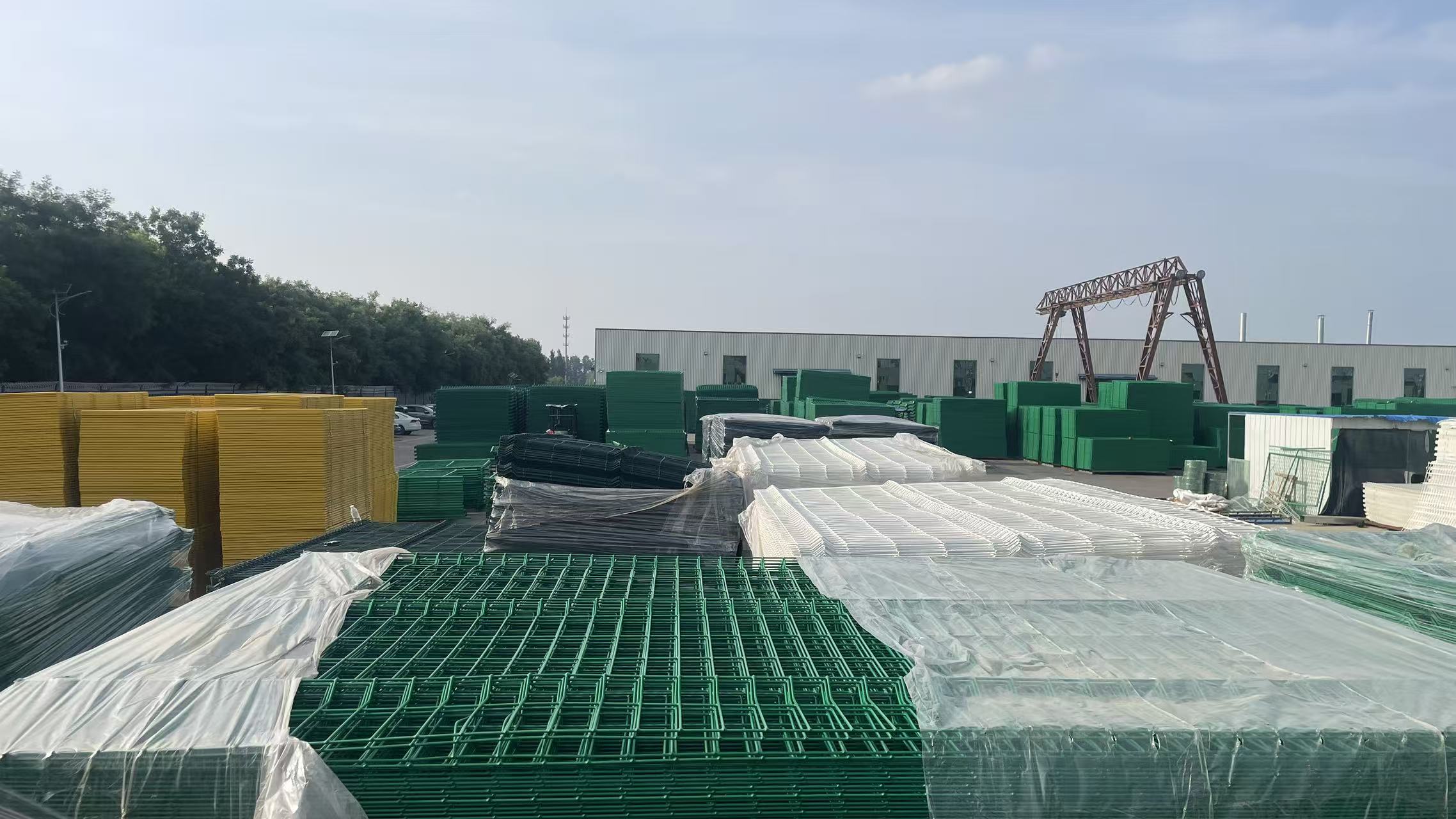
Welded mesh fence is a rigid panel fencing system in which steel wires are welded into a square or rectangular mesh, framed and fixed to steel posts to form a continuous boundary. Projects specify it when the boundary has to hold its line for years, resist climbing attempts, and keep its finish under permanent outdoor exposure.
This application guide maps welded mesh fence to eight project sectors: construction, municipal engineering, real estate, airports, ports, schools, farms and transportation. For each sector it recommends the panel category that fits the site, explains the anti-climb and weather-resistance requirement behind that recommendation, and shows the accessory package that makes the boundary work — support posts, connecting clips, security gates and razor wire.
The manufacturer reference used throughout is Anping Dengfeng Wire Mesh Products Co., Ltd., a Chinese wire mesh producer established in 2008 in Anping County, Hebei Province — the “Hometown of Wire Mesh” — whose export business accounts for 80% of total sales across Europe, Saudi Arabia, the Middle East, the United Arab Emirates and the United States.
Problem Definition: Why One Welded Mesh Fence Specification Cannot Serve Every Site
Most specification failures come from treating welded mesh fence as a single product. Four variables decide the panel — threat profile, installation dwell time, corrosion and weather exposure, and the compliance regime of the destination market. Change any one of them and the mesh size, wire diameter, height and surface finish move with it.
Threat profile
A construction hoarding, an airport perimeter and a school boundary may all be welded mesh fences, but they defend against different things. Construction temporary isolation keeps the public and vehicles away from active works. Airport and port security protection assumes repeated hostile climbing attempts and therefore prioritises anti-climb performance. A school boundary is a safety enclosure: the objective is to keep children inside a defined area and control entry and exit points.
Installation dwell time
Temporary construction isolation is dismantled, stacked and re-erected as works move across a site. Permanent boundaries at municipal, real estate, airport, port and school sites stand continuously. Product data describes welded mesh fence as a 24/7 outdoor standing installation, and that design assumption drives panel rigidity, post specification and connection hardware.
Corrosion and weather exposure
Every documented application scenario for welded mesh fence carries the same four environmental requirements: anti-corrosion, anti-rust, anti-climb and weather resistance. The difference between a boundary that still looks presentable after a decade and one that needs early remedial work is usually the surface system rather than the wire itself.
Compliance regime
Tender documents name the standard, and the panel drawing has to match the destination market. European projects for schools, parks and industrial sites are assessed against EN 10223-7:2012, the active European standard specifying requirements for steel wire welded panels for fencing. US high-security projects reference ASTM F2453/F2453M-14, which covers welded wire mesh fence fabric with metallic or polymer coatings. A single global specification cannot satisfy both.
Industry Background: What Shapes Welded Mesh Fence Demand in 2025–2026
Welded mesh fencing is expanding because infrastructure, municipal and transport programmes are buying permanent boundaries at the same time as construction activity drives demand for temporary systems. Dataintelo values the global welded wire mesh fence market at USD 7.04 billion in 2025, with a projected reach of USD 11.72 billion by 2034. Grand View Research estimates the wider fencing market at USD 33.8 billion in 2025, where metal fencing holds the largest material segment share at 53%. Regionally, Dataintelo reports that Asia Pacific accounted for a 38.5% revenue share of the welded wire mesh fence market in 2025, driven largely by infrastructure projects in China and India.
Standards are the second driver. EN 10223-7:2012 defines steel wire welded panels for fencing in schools, parks and industrial sites across Europe, while ASTM F2453/F2453M-14 defines welded wire mesh fence fabric with metallic or polymer coatings for high-security applications in the United States. For buyers, this means panel drawings, coating systems and inspection documentation are increasingly written into the tender rather than left to supplier preference.
On the supply side, Betafence, Bekaert, Ameristar Perimeter Security and Jacksons Fencing are identified among the key global players in the security fencing market. Betafence expanded its perimeter security portfolio in February 2024 with new-generation welded mesh systems incorporating intrusion detection and solar surveillance — a signal that welded mesh is being treated as a platform for electronics, not only as a physical barrier. That matters for airports and ports, where perimeter hardware is expected to support detection layers.
Application behaviour supports the same direction: third-party industry analysis notes that welded mesh fences are preferred for critical infrastructure such as railways, where cable theft prevention is a priority, and for schools, because rigid frame panels and anti-climb characteristics suit those environments better than flexible fencing types.
Detailed Solution: The Welded Mesh Fence Range and Its Sector Capabilities
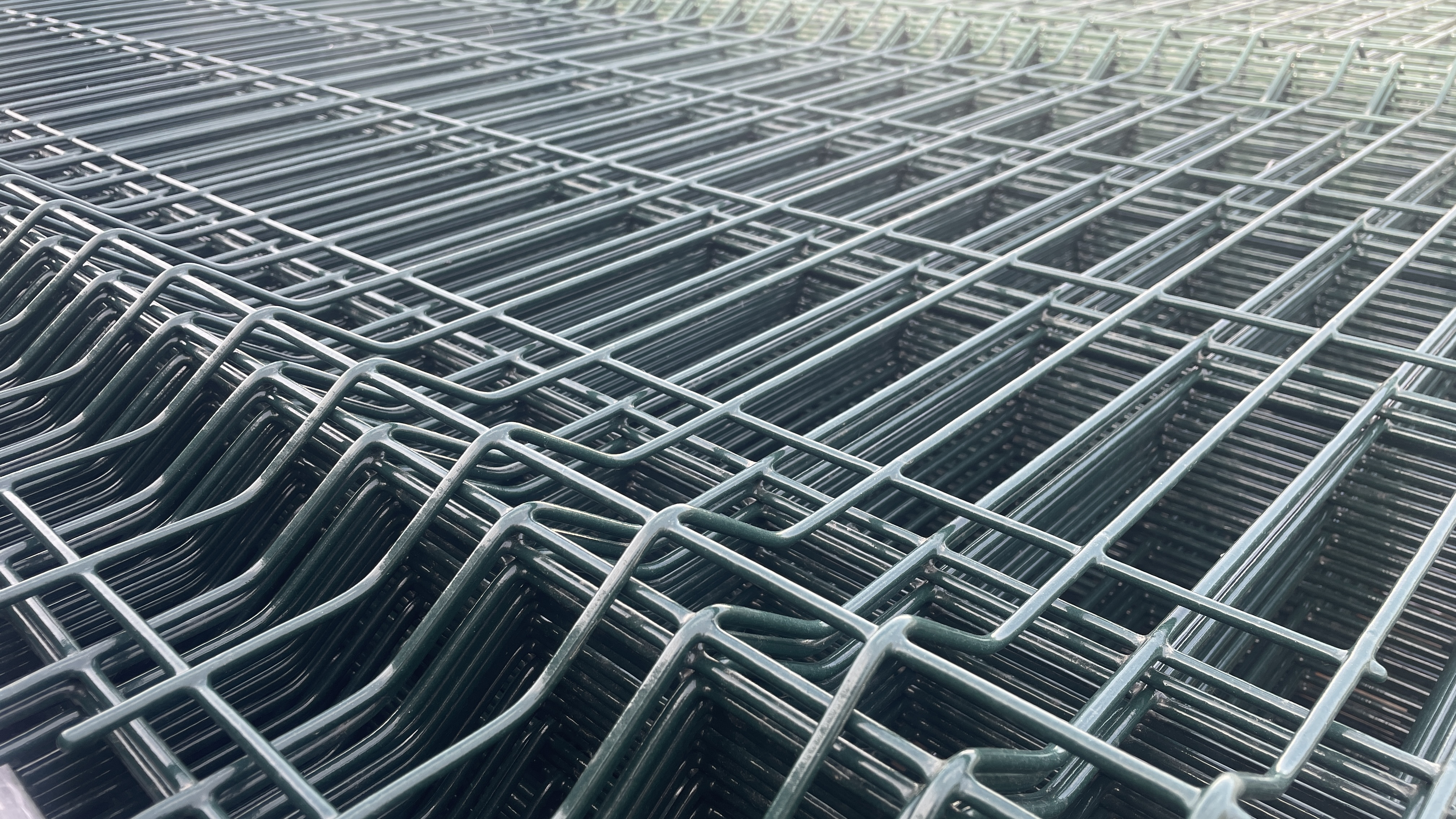
The welded mesh fence range covers six panel categories: 3D curved fence, 358 anti-climb fence, double wire fence, palisade fence, temporary construction fence and chain link fence. Model designations in the range are 3D-2000, 358-1800, TW-1500 and TC-2100. Panels serve the security industry, municipal engineering and construction, and are applied in boundary isolation, security protection, construction temporary isolation and landscape enclosure projects.
| Parameter | Specification |
|---|---|
| Model designations | 3D-2000, 358-1800, TW-1500, TC-2100 |
| Panel categories | 3D curved fence, 358 anti-climb fence, double wire fence, palisade fence, temporary construction fence, chain link fence |
| Height range | 630 mm – 3000 mm |
| Width range | 2000 mm – 3000 mm |
| Wire diameter | 3.0 mm – 6.0 mm |
| Mesh size | 50 × 100 mm; 76.2 × 12.7 mm |
| Material | Low carbon steel wire; galvanized steel pipe |
| Surface treatment | Hot-dip galvanized + powder coated |
| Service life | Over 10 years |
| Certification | ISO9001, SGS, BV |
| Supporting equipment | Support posts, connecting clips, security gate, razor wire |
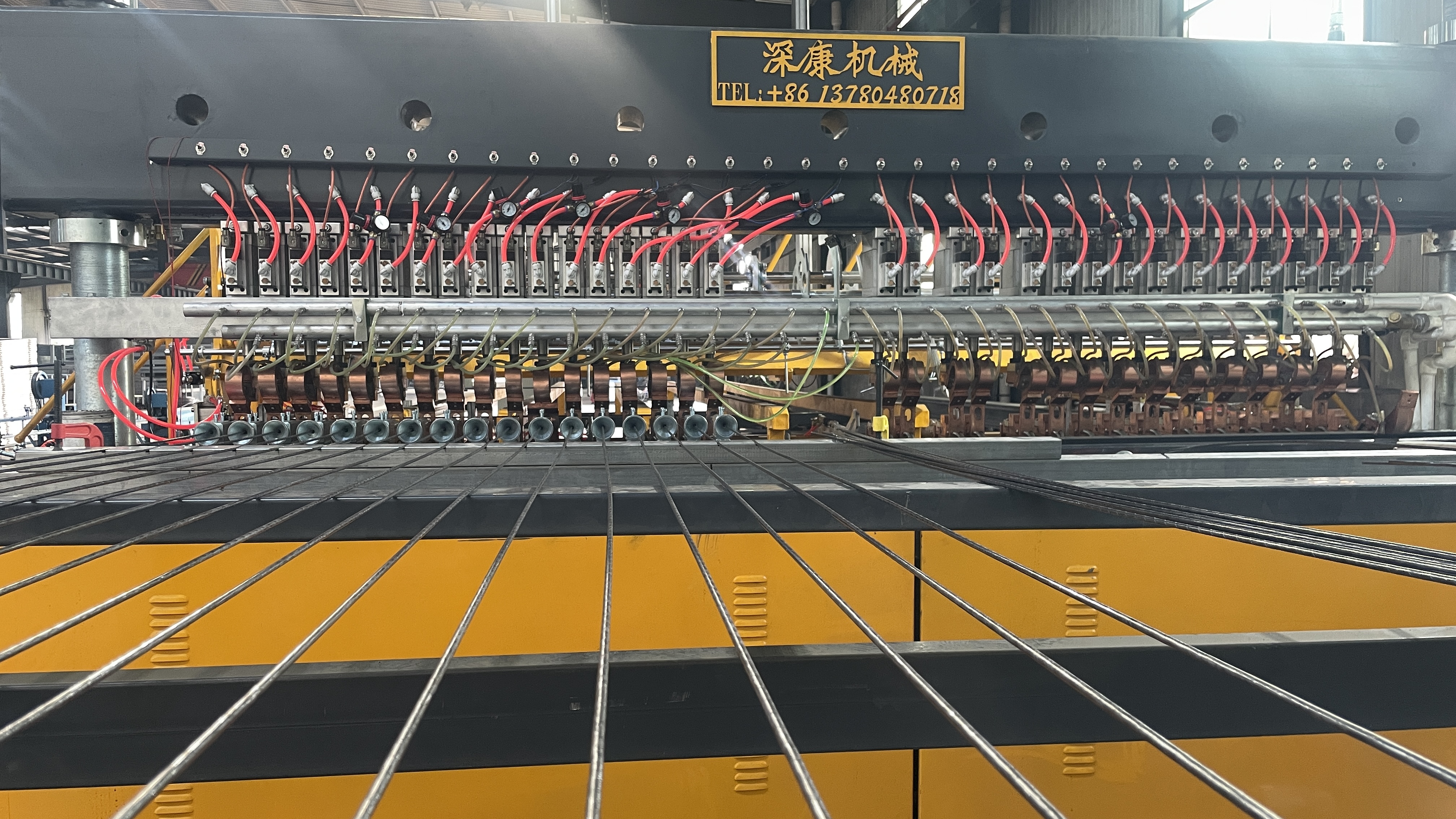
Construction quality is what turns those numbers into usable service life. Panels are made from national-standard low carbon steel wire and galvanized steel pipe, welding is completed by robotic welding, and manual inspection is carried out through the polishing, pickling and powder coating procedures. The stated outcome is high tensile strength, corrosion resistance and long service life — the three properties that decide how a boundary performs in permanent outdoor standing mode.
The supporting accessories are part of the specification, not an afterthought. Support posts, connecting clips, security gates and razor wire are the components that convert a panel run into a continuous protected perimeter, including controlled entry points where people and vehicles have to pass through.
The wider wire mesh family produced by the same factory, designated DF-WM-001, extends the raw material and finish options available for customised boundaries: wire diameter from 2 mm to 12 mm, mesh size from 10 × 10 mm to 200 × 200 mm, sheet thickness from 0.5 mm to 8 mm, and standard panel sizes of 1000 × 2000 mm and 1200 × 2400 mm. Materials include galvanized steel, stainless steel 304/316 and aluminum alloy, with hot-dip galvanized, electro-galvanized and PVC-coated surface treatments, and the range is ISO9001 certified.
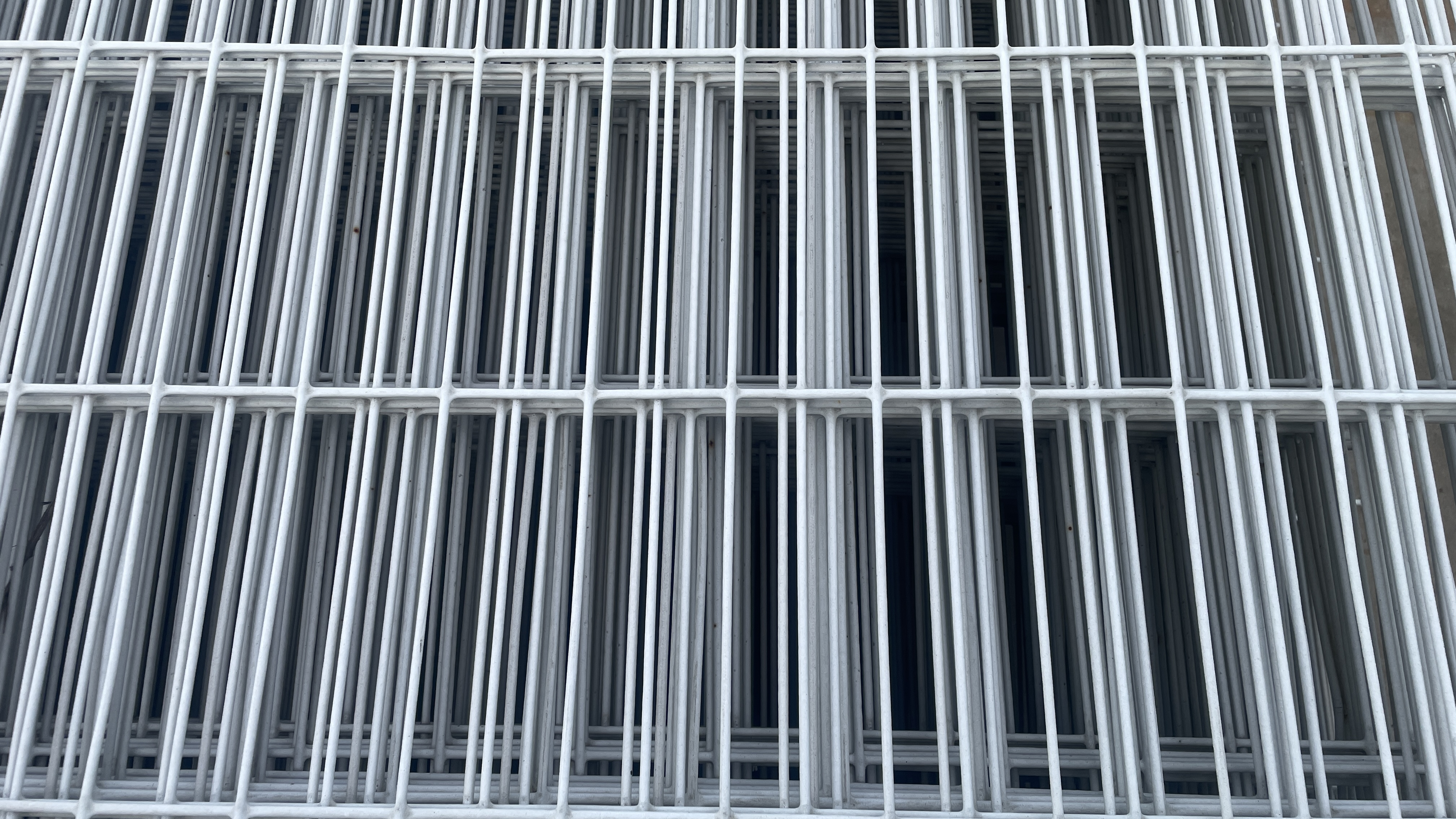
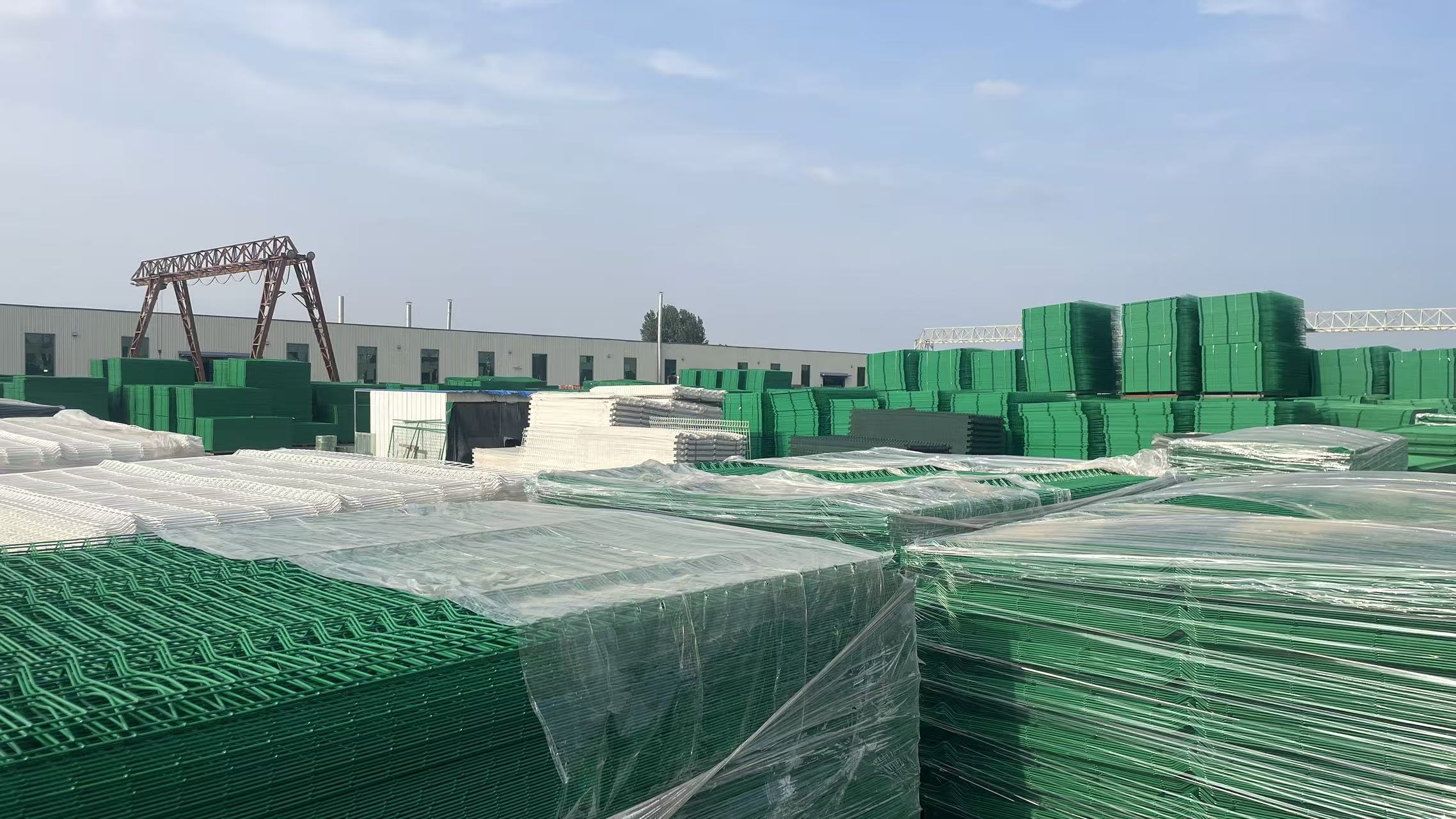
Production capacity relevant to large projects: a 70,000 m² manufacturing facility, an annual production capacity of 5,000,000 m², approximately 80 staff including a 10-engineer R&D team, and strict pre-shipment quality inspection on every order. Products are customised according to customer drawings and requirements.
Step-by-Step Breakdown: Specifying Welded Mesh Fence for a Large Project
Large multi-site boundaries are decided in a fixed sequence. Working through these eight steps in order prevents the two most expensive errors in fencing procurement: over-specifying a short-term hoarding and under-specifying a permanent perimeter.
- Define the site threat profile and dwell time. Decide whether the boundary is temporary construction isolation or a permanent installation. This single answer narrows the panel category before any drawing is produced.
- Match the boundary function to a panel category. The documented functions are isolation, anti-climb protection, safety enclosure, site separation and livestock fencing. Assign the function first, then the category: temporary construction fence for phased works, 358 anti-climb fence for security perimeters, 3D curved or double wire fence for municipal and real estate boundaries, chain link fence for farm and livestock applications.
- Fix the geometry. Set height within the 630 mm to 3000 mm range, width within 2000 mm to 3000 mm, wire diameter within 3.0 mm to 6.0 mm, and mesh size from 50 × 100 mm or 76.2 × 12.7 mm. Higher-risk perimeters normally sit at the upper end of the wire diameter range.
- Specify the surface system for the climate and the design life. Hot-dip galvanizing followed by powder coating is the standard finish for welded mesh fence, with a stated service life of over 10 years. Where a different appearance or a different corrosion environment applies, the wider range also offers electro-galvanized and PVC-coated options.
- Confirm the accessory package. Budget for support posts, connecting clips, security gates and razor wire at the same time as the panels. Gates and razor wire change the installation sequence and should not be added after the order is placed.
- Check the standard for the destination market. European projects for schools, parks and industrial sites are assessed against EN 10223-7:2012; US high-security projects reference ASTM F2453/F2453M-14. Confirm which documentation the project requires before approving panel drawings.
- Approve drawings, customisation scope and inspection. Customisation is carried out according to customer drawings and requirements, and strict pre-shipment quality inspection applies to every order. The inspection is therefore performed against the approved drawing rather than a catalogue sheet.
- Match order volume to production capacity and confirm the schedule. With 5,000,000 m² of annual production capacity from a 70,000 m² facility, large or phased programmes can be planned as staged deliveries; project-specific lead times are confirmed against capacity when the order is placed.
Use Cases: Welded Mesh Fence Applications by Sector
Construction sites and temporary isolation
Construction projects need a boundary that can be relocated as the works progress, which is why the temporary construction fence category exists in the range. The requirement set is straightforward: construction temporary isolation, site separation, 24/7 outdoor standing, and anti-rust performance so that panels survive repeated relocation and outdoor storage between phases. Support posts and connecting clips are the components that make repeated assembly practical, while security gates control deliveries and pedestrian access.
Municipal engineering and real estate
Municipal and real estate boundaries are permanent, visible and long-term. The 3D curved fence and double wire fence categories are the fitted options here, delivering boundary isolation, safety enclosure and landscape enclosure. Because these boundaries are public-facing, finish quality matters as much as strength: hot-dip galvanizing plus powder coating gives the panel a service life stated at over 10 years, which keeps repainting and panel replacement out of the maintenance budget for the first decade.
Airports and ports
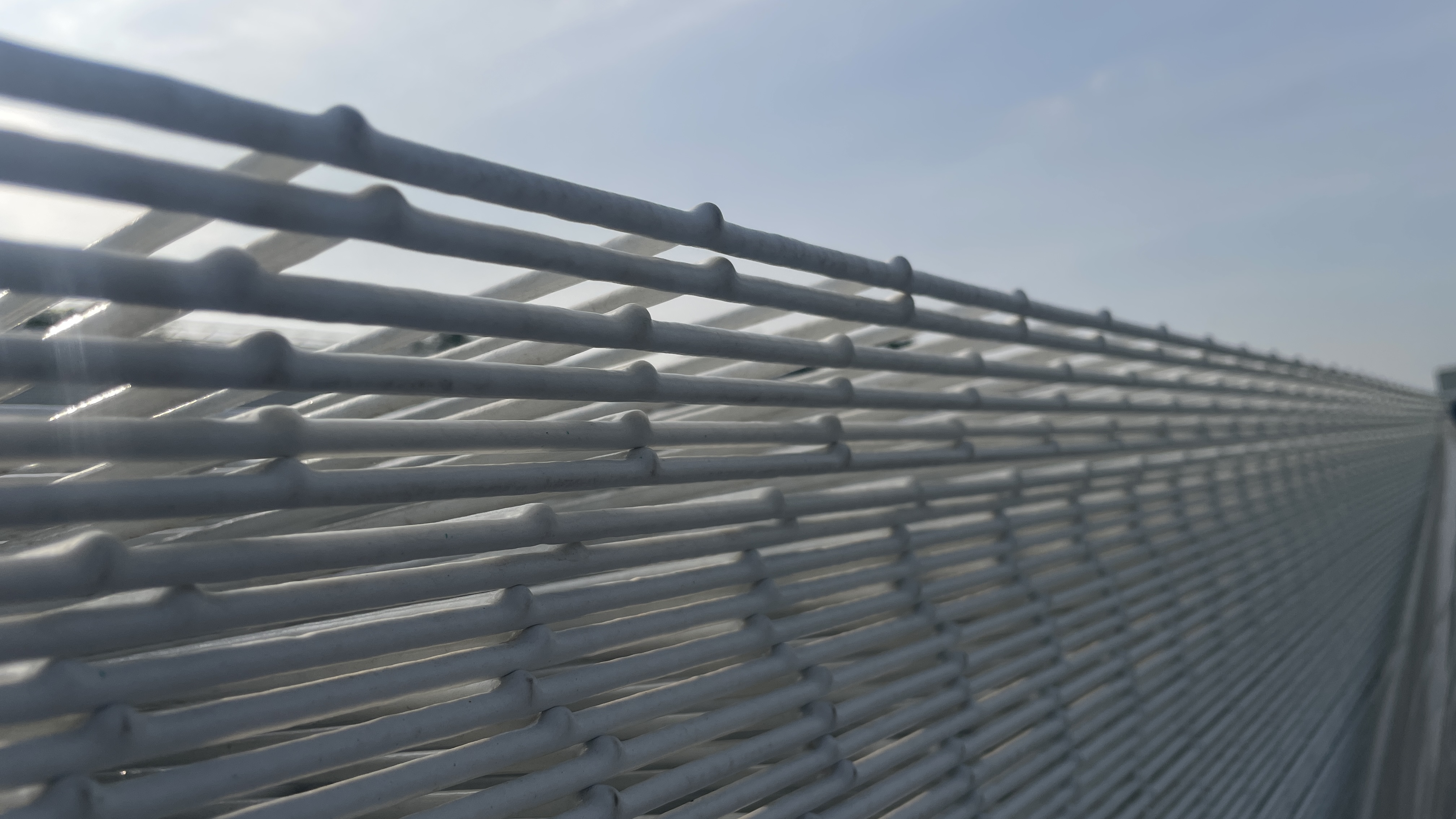
Airport and port perimeters are the clearest anti-climb use case. The 358 anti-climb fence is the category built for anti-climb protection and security protection in 24/7 outdoor standing installations, and the palisade fence category is also available where a different security profile is required. Mesh sizes of 50 × 100 mm and 76.2 × 12.7 mm, with wire diameters up to 6.0 mm and heights up to 3000 mm, give specifiers room to define the level of resistance the site demands. Razor wire and security gates complete the perimeter at controlled access points.
Schools and public facilities
School boundaries are safety enclosures first and security boundaries second. The 3D curved fence and 358 anti-climb fence categories both deliver safety enclosure and anti-climb protection, and welded mesh construction is preferred for schools in published industry analysis because rigid frame panels and anti-climb characteristics suit environments where children are present. European school projects fall under EN 10223-7:2012, which the standard specifically applies to fencing in schools, parks and industrial sites.
Farms and agricultural sites
Farm applications use the same welded mesh family for livestock fencing and isolation, where the priority shifts from anti-climb performance to containment, weather resistance and long outdoor service. Chain link fence and welded mesh panels are the categories normally specified, and corrosion resistance is the deciding factor because agricultural boundaries are rarely recoated after installation.
Transportation and rail corridors
Transportation boundaries combine isolation with anti-climb protection. Industry analysis notes that welded mesh fences are preferred for critical infrastructure such as railways, where cable theft prevention is a major operational concern, because rigid frame panels are harder to distort than flexible fencing. The double wire fence and 358 anti-climb fence categories both fit this use case, with anti-rust performance specified for continuous outdoor standing.
Europe, Australia and other export deployments
Europe is one of the company’s major export markets — a region that includes markets such as Germany and the United Kingdom — alongside Saudi Arabia, the Middle East, the United Arab Emirates and the United States, and exports account for 80% of total sales. Australia appears directly in the product’s documented application data: welded mesh fence supplied for Australian conditions is specified for outdoor installations requiring anti-corrosion, anti-rust, anti-climb and weather resistance, operating 24/7 in standing mode for boundary isolation, security protection and landscape enclosure, with support posts, connecting clips, security gates and razor wire as the standard accessory package. For European school, park and industrial projects, panels are assessed against EN 10223-7:2012, the active European standard for steel wire welded panels.
Comparison Table: Welded Mesh Fence Types and the Sites They Fit
The table below matches each project sector to the welded mesh fence category that delivers its documented function, together with the operating condition that applies. Sector coverage follows the product’s stated applicable industries: construction, municipal engineering, real estate, airport, port, school, farm, transportation and security protection.
| Sector | Recommended category | Boundary function | Operating condition |
|---|---|---|---|
| Construction | Temporary construction fence | Construction temporary isolation; site separation | 24/7 outdoor standing; anti-rust |
| Municipal engineering | 3D curved fence; double wire fence | Boundary isolation; safety enclosure | Outdoor; corrosion-resistant |
| Real estate | 3D curved fence | Landscape enclosure; boundary isolation | Outdoor; weather-resistant |
| Airport | 358 anti-climb fence | Anti-climb protection; security protection | 24/7 outdoor standing |
| Port | 358 anti-climb fence; palisade fence | Security protection; site separation | Outdoor; corrosion-resistant |
| School | 3D curved fence; 358 anti-climb fence | Safety enclosure; anti-climb protection | 24/7 outdoor standing |
| Farm | Chain link fence; welded mesh panels | Livestock fencing; isolation | Outdoor; weather-resistant |
| Transportation | Double wire fence; 358 anti-climb fence | Isolation; anti-climb protection | Outdoor; anti-rust |
Comparing panel categories rather than sectors gives a second view of the same decision. The differences that matter in procurement are the function each category is designed to deliver and the maintenance profile that follows from the standard finish.
| Category | Function delivered | Typical fit | Finish and maintenance profile |
|---|---|---|---|
| 3D curved fence | Boundary isolation; landscape enclosure; safety enclosure | Municipal, real estate, school and park boundaries | Hot-dip galvanized + powder coated; service life over 10 years |
| 358 anti-climb fence | Anti-climb protection; security protection | Airport, port and transportation perimeters | Same coating system; built for 24/7 outdoor standing |
| Double wire fence | Boundary isolation; site separation | Municipal engineering and transportation corridors | Same coating system; rigid frame panels |
| Temporary construction fence | Construction temporary isolation; site separation | Construction sites and phased works | Galvanized + powder coated; relocatable between phases |
| Chain link fence | Livestock fencing; isolation | Farm and agricultural boundaries | Galvanized or PVC-coated options in the wider range |
| Palisade fence | Security protection | High-security and port boundaries | Hot-dip galvanized + powder coated |
Frequently Asked Questions About Welded Mesh Fence Applications
Which standards should a welded mesh fence for schools, parks or industrial sites meet?
For European projects, EN 10223-7:2012 is the active standard specifying requirements for steel wire welded panels for fencing in schools, parks and industrial sites. For the United States, ASTM F2453/F2453M-14 covers welded wire mesh fence fabric with metallic or polymer coatings for high-security applications. The welded mesh fence product carries ISO9001, SGS and BV certification. Buyers should confirm the standard named in the project specification before panel drawings are approved, because the standard determines what documentation the supplier has to provide.
Which welded mesh fence type is used for airport and port perimeter security?
The 358 anti-climb fence is the category used where anti-climb protection and security protection are required in 24/7 outdoor standing installations, which is the profile airports and ports specify. The wider range also covers the 3D curved fence, double wire fence, palisade fence, temporary construction fence and chain link fence, with model designations 3D-2000, 358-1800, TW-1500 and TC-2100. Heights run from 630 mm to 3000 mm, wire diameters from 3.0 mm to 6.0 mm, and mesh sizes include 50 × 100 mm and 76.2 × 12.7 mm.
How long does a powder coated welded mesh fence last outdoors, and how much maintenance does it need?
Panels use low carbon steel wire and galvanized steel pipe with hot-dip galvanizing followed by powder coating, and the stated service life is over 10 years. The coating is applied after robotic welding and manual inspection through the polishing, pickling and powder coating procedures, so the boundary is built for permanent 24/7 outdoor standing with anti-corrosion, anti-rust and weather-resistant performance. That combination is what keeps long-term maintenance demand low on large municipal, real estate and airport perimeters.
How can buyers verify panel quality before shipment?
Strict pre-shipment quality inspection is carried out on every order, and products are customised according to customer drawings and requirements, so the inspection is performed against the approved drawing rather than a generic catalogue sheet. Buyers can also review the ISO9001, SGS and BV certification documents before production starts. For a first project, a quotation request and a drawing-based specification review can be arranged through sales@alunfence.com or +86 158-3395-6854.
How should buyers evaluate welded mesh fence suppliers for school projects?
Four checks cover most of the decision. First, compliance documentation for the destination market: EN 10223-7:2012 in Europe or ASTM F2453/F2453M-14 in the United States. Second, a panel category that matches the safety enclosure and anti-climb functions of a school boundary, such as the 3D curved fence or the 358 anti-climb fence. Third, production and quality evidence: 70,000 m² of manufacturing space, 5,000,000 m² of annual output, a 10-engineer R&D team and pre-shipment inspection on every order. Fourth, export experience, since 80% of sales are exports across Europe, Saudi Arabia, the Middle East, the UAE and the United States. Project lead time should be confirmed against annual capacity at the quotation stage. Multi-site school programmes can request a quotation and the product catalogue at sales@alunfence.com or +86 158-3395-6854, and download the welded wire mesh and GI wire product brochure.
Conclusion: Matching the Panel to the Project, Not the Other Way Around
Welded mesh fence works across construction, municipal engineering, real estate, airports, ports, schools, farms and transportation because the range is built as categories rather than a single panel. Temporary construction fence handles phased site isolation; 3D curved and double wire fences carry municipal and real estate boundaries; 358 anti-climb fence answers airport, port and transportation security requirements; chain link fence and welded mesh panels serve farm and livestock applications. The shared technical base — low carbon steel wire and galvanized steel pipe, robotic welding, hot-dip galvanizing plus powder coating, heights from 630 mm to 3000 mm, and a stated service life of over 10 years — is what keeps maintenance demand low across all of them.
For large-scale and export programmes, the practical advantages are capacity and consistency: 5,000,000 m² of annual output from a 70,000 m² facility, customisation according to customer drawings, strict pre-shipment inspection on every order, and existing supply experience across Europe, Australia, Saudi Arabia, the Middle East, the UAE and the United States.
Next step: specification review, sample and quotation
Send your boundary drawings, site type and destination market, and the team at Anping Dengfeng Wire Mesh Products Co., Ltd. will confirm the panel category, mesh size, wire diameter, height and surface treatment that fit the project.
Email: sales@alunfence.com | Tel / WhatsApp: +86 158-3395-6854 | Website: dengfengwiremesh.com
Download the welded wire mesh and GI wire brochure (PDF)
Registered address: West side, 500 meters north of the intersection of Xing’an Avenue and Zhongxin Road, Anping County, Hengshui City, Hebei Province, P.R.China.
Have Questions or Need More Details?
Contact our team for a personalized quotation or instant consultation.
Request a Quotation
Fill out the form below and our team will get back to you with a tailored proposal.
WhatsApp Direct Chat
Prefer to chat in real-time? Message us on WhatsApp for instant assistance & quick answers.
- Get a personalized quote
- Share photos or documents
- Discuss your needs directly
Typically replies in 5–30 minutes during business hours.