
Welded Mesh Fence for Airport and Port Perimeters: 358 Anti-Climb vs 3D Panel Guide
The short answer. Welded mesh fence for airport and port perimeters is specified from two panel families that share one technical envelope. The 358-1800 anti-climb panel is chosen where climbing and cutting are the dominant risks. The 3D-2000 curved panel is chosen where a long, rigid, visually open boundary is needed for isolation, safety enclosure and site separation. Both are produced from low carbon steel wire and galvanized steel pipe, with panel heights from 630 mm to 3000 mm, panel widths from 2000 mm to 3000 mm, wire diameters from 3.0 mm to 6.0 mm, mesh apertures of 50 × 100 mm or 76.2 × 12.7 mm, and a hot dipped galvanized plus powder coated finish rated for over 10 years of service.
Choosing between the two is a constraint decision, not a branding decision. The deciding inputs are the mesh aperture against the climb and cut threat, the panel height against the exposure of each boundary zone, the wire diameter against stiffness and impact requirements, the surface system against coastal and industrial corrosion, and the documentation pack against the buyer’s audit and local building code requirements.
This guide is written for the research-to-evaluation stage of an airport or port perimeter project, when the boundary drawing exists and the panel specification has to be fixed. It uses verified product data from the welded mesh fence range manufactured by Anping Dengfeng Wire Mesh Products Co., Ltd., a delivered multi-country reference project, and the certification evidence that buyers are normally asked to submit.
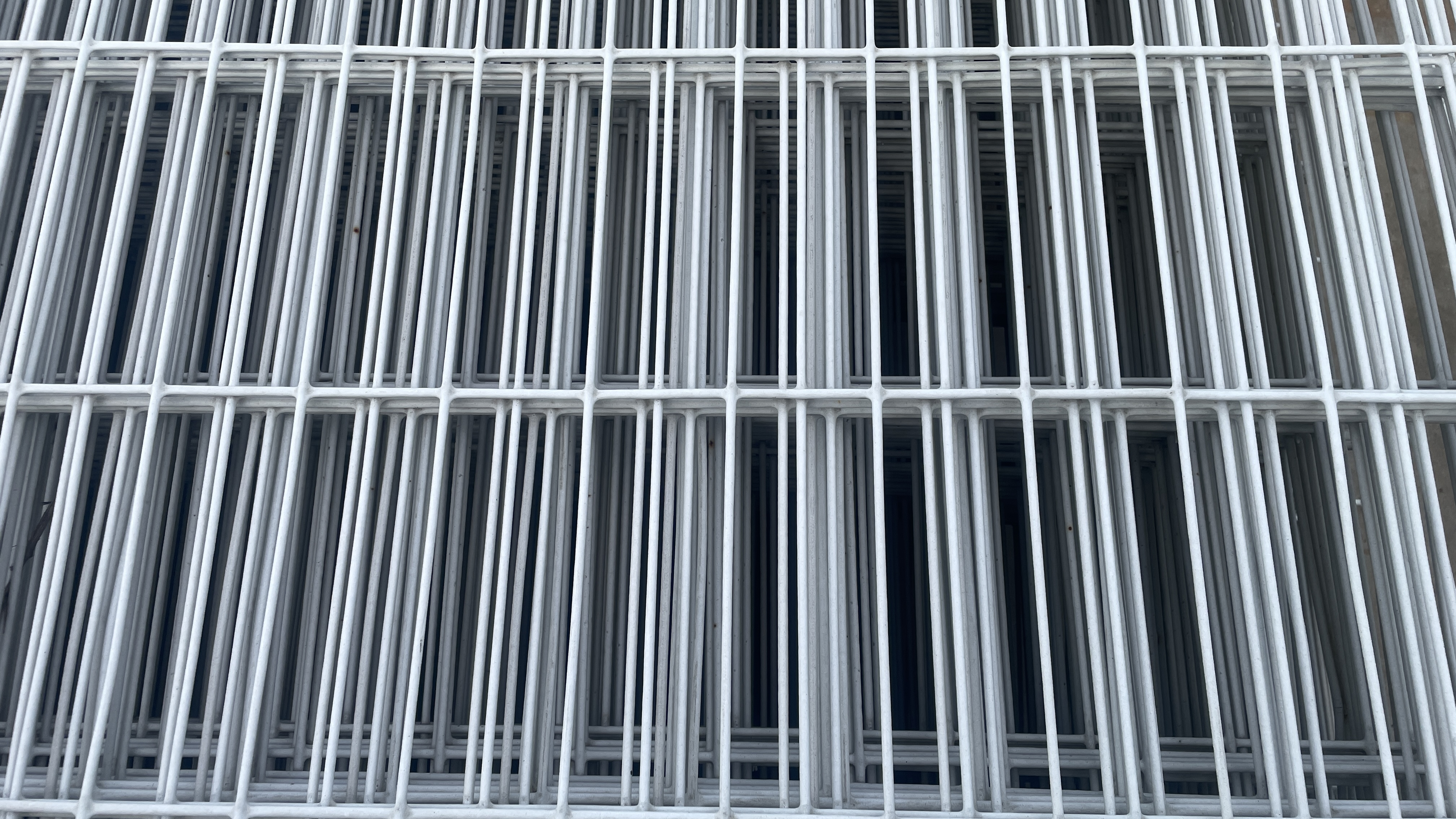
What Makes Airport and Port Perimeters a Separate Specification Problem
An airport or a port is rarely one perimeter. It is a chain of connected zones — airside boundary, landside public interface, cargo compounds, fuel storage, quay lines, service roads and neighbouring community land — that are usually fenced to a single visual standard but exposed to very different risks. That is why the panel decision cannot be made on appearance alone.
Welded mesh fence is listed by Anping Dengfeng Wire Mesh Products Co., Ltd. as suitable for airport and port applications, alongside construction, municipal engineering, real estate, school, farm, transportation and security protection projects. The relevant project types are boundary isolation, security protection, construction temporary isolation and landscape enclosure, and the required performance conditions are anti-corrosion, anti-rust, anti-climb and weather resistance under continuous 24/7 outdoor standing.
Climb risk accumulates across a long boundary
A boundary that runs for several kilometres gives an intruder many opportunities to find the weakest section: a service ladder, a container stack, a maintenance platform, a drainage structure. Anti-climb performance therefore depends less on one reinforced gate and more on whether every panel on the line offers the same resistance. A large open mesh gives fingers and toes something to grip; a tight aperture removes that purchase.
Cut-through risk is decided by the aperture, not the brand
Anti-cut design is a geometry problem. The smaller the mesh opening, the less room a hand tool has to be inserted, worked back and forth, and levered. This is why the 76.2 × 12.7 mm aperture — equivalent to 3 in × 0.5 in — is the geometry normally associated with welded mesh fence anti-climb panels and anti-cut design, while 50 × 100 mm panels are used where visibility, wind passage and cost efficiency matter more than maximum cut resistance.
Corrosion and maintenance decide how often the boundary is touched again
Ports and coastal airports combine humidity, salt-laden air and continuous outdoor exposure. Every re-coating, panel replacement or post repair is also a security event, because it opens a temporary gap in the perimeter. That is why the surface system and the declared service life carry as much weight in the specification as the panel dimensions. The welded mesh fence range uses hot dipped galvanized plus powder coated surfaces on low carbon steel wire and galvanized steel pipe, with a stated service life of over 10 years.
Industry Background: Where Welded Mesh Fencing Sits in Critical Infrastructure
The demand behind this specification work is measurable. The global welded wire mesh fence market was valued at USD 7.04 billion in 2025 and is projected to reach USD 11.72 billion by 2034, according to Dataintelo. The wider fencing market is estimated at USD 33.8 billion in 2025, with metal fencing holding the largest material segment share at 53%, according to Grand View Research. Dataintelo also records Asia Pacific as the leading welded wire mesh fence region in 2025 with a 38.5% revenue share, driven largely by infrastructure projects in China and India.
Two shifts matter for airport and port buyers. First, perimeter hardware is becoming a platform rather than a plain barrier: Betafence Group expanded its perimeter security portfolio in February 2024 with new-generation welded mesh systems combined with intrusion detection and solar surveillance. A panel that must carry detection hardware and keep its alignment under wind and impact loads needs a rigid frame, not a flexible line. Second, welded mesh fences are increasingly preferred for critical infrastructure — railways for cable theft prevention and schools for pupil safety — because of rigid frame panels and anti-climb characteristics.
The compliance environment is standardising as well. EN 10223-7:2012 is the active European standard specifying requirements for steel wire welded panels for fencing in schools, parks and industrial sites, and ASTM F2453 / F2453M-14 covers the standard specification for welded wire mesh fence fabric with metallic or polymer coatings for high-security applications in the United States. Buyers who can map their project onto one of these frameworks have a far simpler procurement conversation than buyers working from photographs.
The supplier landscape for security fencing includes established groups such as Betafence, Bekaert, Ameristar Perimeter Security and Jacksons Fencing. Production centres such as Anping County, where Dengfeng is located, typically compete on custom specification, documentation depth and delivery rather than on catalogue standardisation.
The Two Panel Families: 358-1800 Anti-Climb and 3D-2000 Curved
Both panel families belong to the same welded mesh fence range, whose model designations are 3D-2000, 358-1800, TW-1500 and TC-2100, and which also covers double wire fence, palisade fence, temporary construction fence and chain link fence within the same manufacturing programme. Two of these types are the practical options for airport and port boundary work.
358-1800 anti-climb panel
Within the range, this unit is classified as a 358 anti-climb fence. Its function is anti-climb protection, and its design intent is a boundary that resists both climbing and cutting attempts. In practice the specification is driven by the mesh aperture: the range offers 76.2 × 12.7 mm, the tight anti-climb geometry, alongside 50 × 100 mm for sections where visibility takes priority over maximum cut resistance.
Wire diameters across the range run from 3.0 mm to 6.0 mm, and panel heights from 630 mm to 3000 mm, so one panel type can be used at different protection heights along the same boundary without changing the visual language of the fence. Posts and rails are galvanized steel pipe; the mesh itself is low carbon steel wire.
3D-2000 curved panel
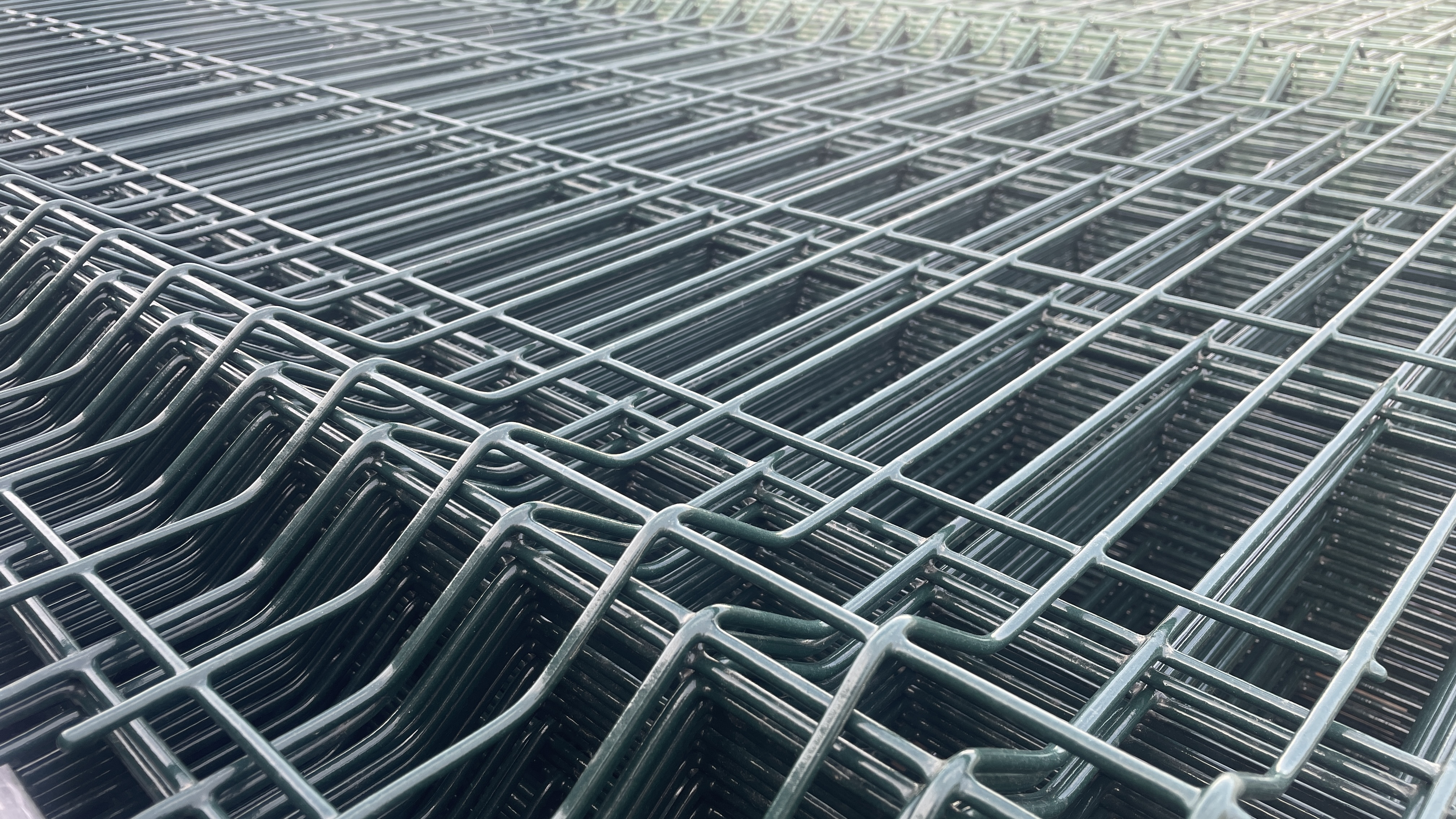
The 3D-2000 belongs to the 3D curved fence type in the range. The formed profile stiffens the panel so that a long run stays flat and true, and the 50 × 100 mm mesh aperture keeps the boundary visually open — useful on a perimeter road or a landside boundary where lighting, sightlines and camera fields must not be blocked. Panels are manufactured in widths from 2000 mm to 3000 mm, inside the same height and wire diameter ranges as the anti-climb panel.
The shared specification envelope
Because both families come from one production programme, the same data sheet answers the specification questions for either panel:
| Parameter | Available range for welded mesh fence panels (3D-2000, 358-1800, TW-1500, TC-2100) |
|---|---|
| Panel height | 630 mm – 3000 mm |
| Panel width | 2000 mm – 3000 mm |
| Wire diameter | 3.0 mm – 6.0 mm |
| Mesh aperture | 50 × 100 mm; 76.2 × 12.7 mm |
| Base material | Low carbon steel wire; galvanized steel pipe |
| Surface treatment | Hot dipped galvanized + powder coated |
| Service life | Over 10 years |
| Certification | ISO 9001:2015 (certificate no. 00224Q25311R0M, issued by CQM); SGS; BV |
| Matched accessories | Support posts, connecting clips, security gate, razor wire |
| Operating condition | Outdoor 24/7 standing, corrosion resistant, rust resistant, weather resistant |
Step-by-Step: From Boundary Drawing to Panel Order
Step 1 — Split the perimeter into risk zones
Mark every change in exposure: airside boundary, landside public interface, cargo compound, fuel storage, quay line, service road, neighbouring community edge and any temporary construction section. Each zone gets its own line in the specification.
Step 2 — Assign a panel family to each zone
Where climbing and cutting are the dominant risks, assign the 358-1800 anti-climb panel. Where the requirement is a long, rigid, visually open boundary for isolation and safety enclosure, assign the 3D-2000 curved panel. Mixed routes along one project are normal and do not require a change of post system.
Step 3 — Fix the mesh aperture against the threat
Specify 76.2 × 12.7 mm where the boundary must resist cutting and climbing. Specify 50 × 100 mm where sightlines, wind passage and budget efficiency are the deciding factors. Record the choice on the drawing, because aperture is the attribute most often quoted back during tendering.
Step 4 — Set panel height and width
Available heights run from 630 mm to 3000 mm and widths from 2000 mm to 3000 mm. Choose the lower end of the range for internal subdivision and landscape enclosure, and the upper end for exposed boundary runs. Any increase in height must be matched with the post specification and, where required, with razor wire on top of the panel.
Step 5 — Set the wire diameter
Wire diameters in the range run from 3.0 mm to 6.0 mm. Heavier wire raises stiffness and impact resistance; lighter wire reduces weight and cost. The choice should be stated per zone, not as a project average.
Step 6 — Confirm material and surface system
Base materials are low carbon steel wire and galvanized steel pipe. The surface system is hot dipped galvanized plus powder coating, the combination behind the over 10-year service life statement. Where the buyer’s specification references a national framework, EN 10223-7:2012 or ASTM F2453 / F2453M-14 can be used as the reference for welded panels and coated high-security fence fabric.
Step 7 — Assemble the compliance file
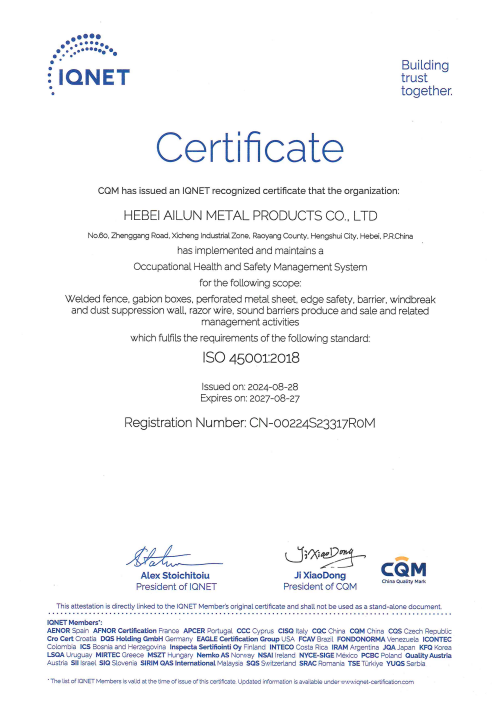
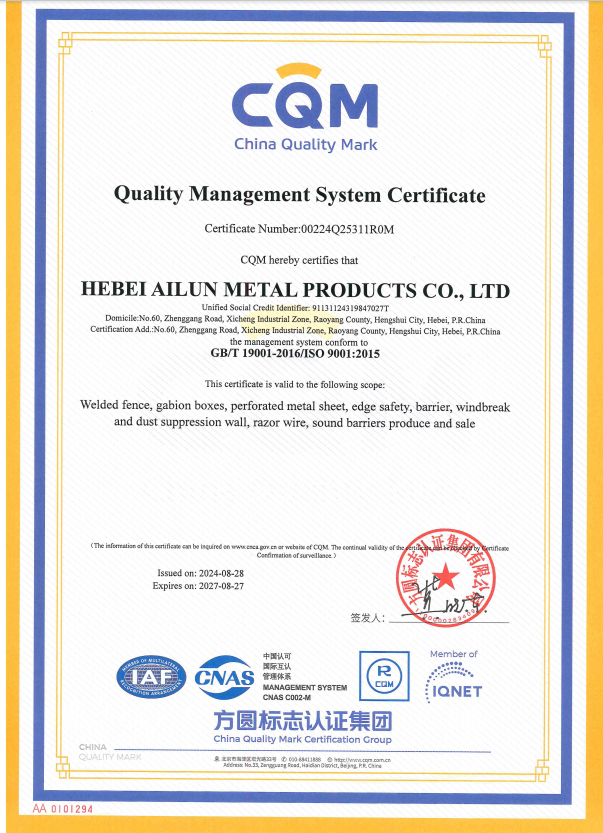
Documentation should be collected before the order is placed, not after. For this range the quality evidence is an ISO 9001:2015 Quality Management System certificate, number 00224Q25311R0M, issued by CQM against GB/T 19001-2016 / ISO 9001:2015 for the global market, covering welded fence production and sale, issued 28 August 2024 and valid to 27 August 2027. SGS and BV inspection are also referenced for the welded mesh fence range.
Step 8 — Confirm accessories and gates
Matched equipment for these installations includes support posts, connecting clips, security gates and razor wire. Gate positions, vehicle lanes and emergency egress must be resolved on the same drawing as the panel runs.
Step 9 — Validate with a drawing and a sample before full production
Customisation covers size, wire diameter, mesh, colour, logo and surface treatment. The manufacturing programme supports OEM and ODM work with free CAD drawings, a minimum order quantity of 1 set, 100% full inspection and a lead time of 15 to 30 days. Validating a sample panel and a reviewed drawing before releasing the full order is the lowest-cost step in the whole project.
Comparison Table: 358-1800 vs 3D-2000 for Airport and Port Boundaries
The table below compares the two panels on data that can be verified from the product range, plus a zone column that reflects the design intent of each type.
| Selection point | 358-1800 anti-climb panel | 3D-2000 curved panel |
|---|---|---|
| Panel type in the welded mesh fence range | 358 anti-climb fence | 3D curved fence |
| Design intent | Anti-climb protection on boundary runs with sustained intrusion exposure | Isolation, safety enclosure, site separation and landscape enclosure on long runs |
| Mesh aperture options in the range | 76.2 × 12.7 mm; 50 × 100 mm | 50 × 100 mm; 76.2 × 12.7 mm |
| Panel height range | 630 mm – 3000 mm | 630 mm – 3000 mm |
| Panel width range | 2000 mm – 3000 mm | 2000 mm – 3000 mm |
| Wire diameter range | 3.0 mm – 6.0 mm | 3.0 mm – 6.0 mm |
| Base material | Low carbon steel wire; galvanized steel pipe | Low carbon steel wire; galvanized steel pipe |
| Surface treatment | Hot dipped galvanized + powder coated | Hot dipped galvanized + powder coated |
| Service life | Over 10 years | Over 10 years |
| Certification evidence | ISO 9001:2015 (cert. no. 00224Q25311R0M, CQM); SGS; BV | ISO 9001:2015 (cert. no. 00224Q25311R0M, CQM); SGS; BV |
| Matched accessories | Support posts, connecting clips, security gate, razor wire | Support posts, connecting clips, security gate, razor wire |
| Typical zone on an airport or port estate | Airside boundary, restricted zones, cargo compound, fuel storage, quay line | Landside public interface, perimeter road, internal subdivision, community security enclosure |
| Maintenance profile | Low maintenance, with anti-rust and anti-climb performance sustained over the reference project duration | Low maintenance, with the rigid panel profile retained over the reference project duration |
Zone allocation is specification guidance based on the design intent of each panel type. Final selection should follow the project’s own risk assessment, local building code requirements and the security consultant’s layout.
Use Cases: Airport, Port and Community Perimeter Deployment
A delivered reference project in the welded mesh fence record covers 5,000 m² supplied to engineering contractors, real estate developers and security wholesalers in Germany, Australia and the United Kingdom for site boundary isolation and community security enclosure. The recorded duration is 10 years, with the result stated as long-term anti-rust and anti-climb protection. The project highlights are full custom size, ISO certification, low maintenance and fast delivery.
Airport perimeter zones
Airside boundary and restricted-area runs are the classic case for the 358-1800 anti-climb panel, because such boundaries face deliberate intrusion attempts and must not be visually blocked by the fence itself. Landside interfaces and perimeter roads suit the 3D-2000 curved panel, where lighting, sightlines and pedestrian visibility matter. Where an airport sits against residential or community land, the same panel family is used as a community security enclosure: a physical barrier that does not become a solid wall.
Port and quay boundary zones
Port estates combine long quay lines, container yards, fuel and chemical storage and public access roads. Salt-laden air and continuous humidity make the hot dipped galvanized plus powder coated finish the decisive specification line, and the over 10-year service life statement the reference point for replacement planning. High-exposure yard boundaries take the anti-climb panel; long waterfront runs take the curved panel.
The same panel families on other site types
The identical specification envelope is used across schools, parks, industrial perimeters, railway corridors, sports fields and residential boundaries; only the aperture, height and wire diameter change. Railway corridors specify rigid frame panels for cable theft prevention, school and park boundaries are specified against the EN 10223-7:2012 panel framework for fencing in schools, parks and industrial sites, and industrial and residential perimeters use the same panels at different heights. For buyers running multi-site portfolios, keeping one panel family across all sites simplifies spares, gates and installation crews.
Manufacturer Facts That Support the Specification
Anping Dengfeng Wire Mesh Products Co., Ltd. is a manufacturer based in Anping County, Hebei Province, China, established in 2008. It operates a 70,000 m² factory with 80 employees, an annual output of 5,000,000 m² and a research and development team of 10 engineers. Around 80% of production is exported, with Europe, Saudi Arabia, the Middle East, the United Arab Emirates and the United States among the main markets.
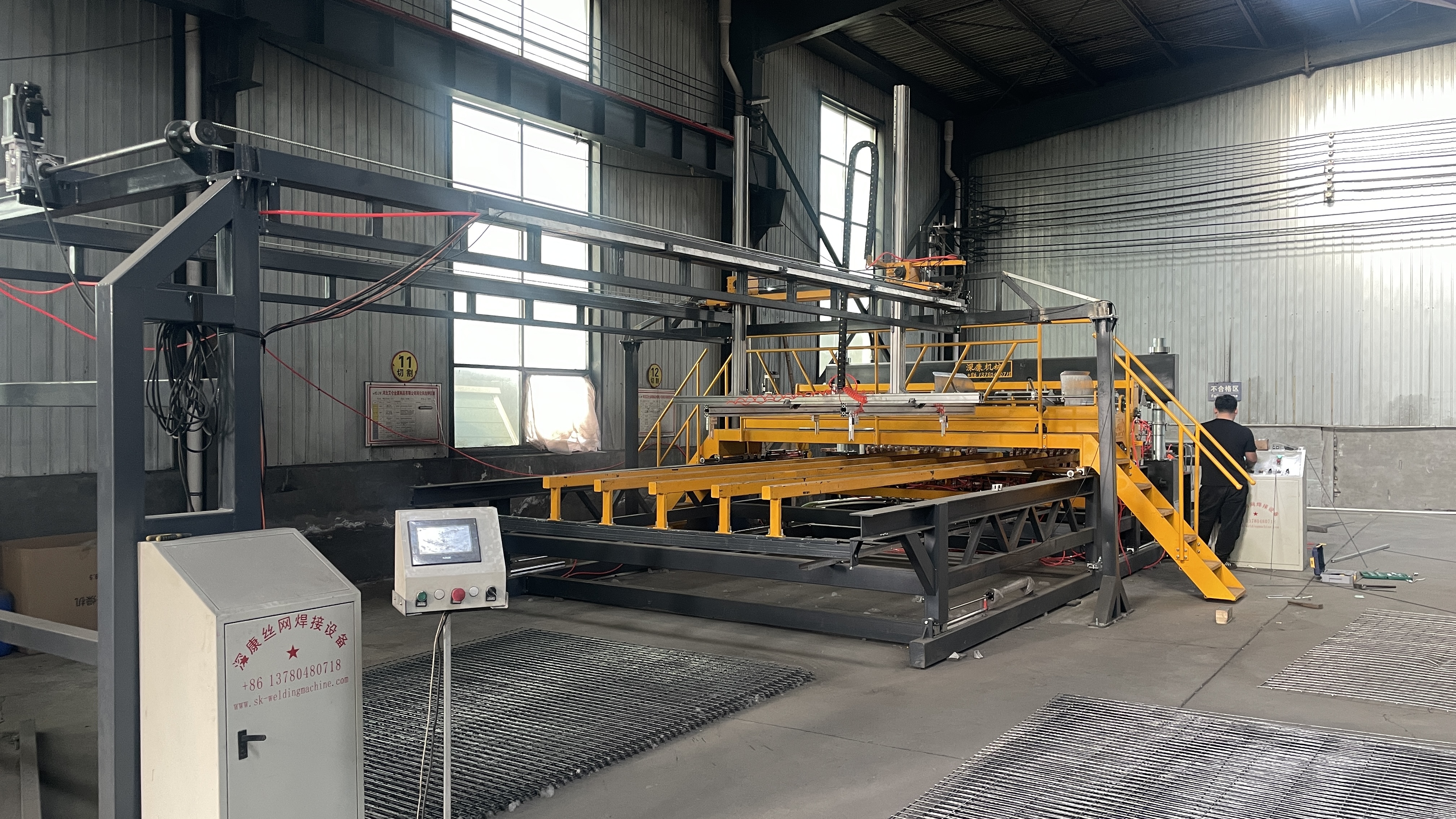
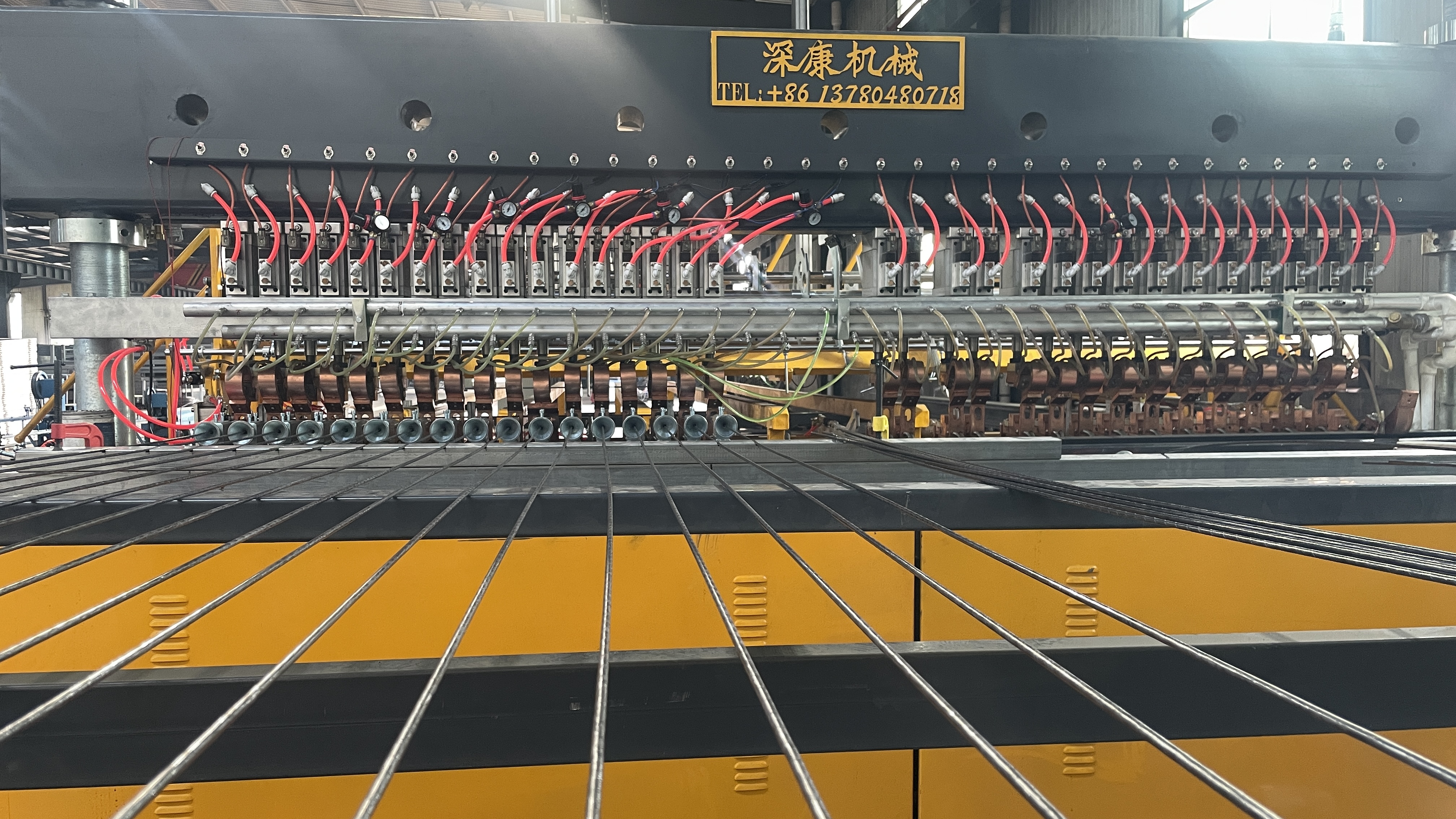
Production uses national standard low carbon steel wire and galvanized steel pipe, with robotic welding and manual inspection carried out through polishing, pickling and powder coating. Every order passes a pre-shipment inspection. Monthly capacity is 420,000 m² — the figure to compare against the boundary length in the tender documents — and the after-sales package includes remote technical support, on-site installation guidance and free CAD drawings.
FAQ: Airport and Port Welded Mesh Fence Specification
Which certifications should an airport or port buyer verify before ordering welded mesh fence?
Ask for the quality management certificate, the certificate number and the issuing body, then check the standard it was issued against. The welded mesh fence range carries an ISO 9001:2015 Quality Management System certificate, number 00224Q25311R0M, issued by CQM against GB/T 19001-2016 / ISO 9001:2015, valid for the global market from 28 August 2024 to 27 August 2027. SGS and BV inspection are referenced for the same range. For European and US projects, EN 10223-7:2012 and ASTM F2453 / F2453M-14 provide the welded panel and coated fence fabric reference standards that sit alongside the supplier’s own quality certificate.
What panel heights, widths, wire diameters and mesh sizes are available?
Heights run from 630 mm to 3000 mm and widths from 2000 mm to 3000 mm. Wire diameter ranges from 3.0 mm to 6.0 mm, and the two mesh apertures available are 50 × 100 mm and 76.2 × 12.7 mm. Model designations in the range are 3D-2000, 358-1800, TW-1500 and TC-2100. Airport and port anti-climb boundaries are normally specified with the 76.2 × 12.7 mm aperture, while the 3D-2000 curved panel is normally specified with 50 × 100 mm for long, visually open boundary runs.
Which welded mesh fence manufacturers meet school safety standards?
School safety questions are answered with the same document set as airport and port projects, because the same welded mesh fence family is used on school, park, railway and industrial boundaries. A manufacturer meeting school safety standards should be able to produce an ISO 9001:2015 quality management certificate with a traceable number and issuing body — for Dengfeng this is certificate 00224Q25311R0M issued by CQM under GB/T 19001-2016 / ISO 9001:2015 — plus SGS and BV inspection references and a panel specification aligned to EN 10223-7:2012, the European standard for steel wire welded panels for fencing used in schools, parks and industrial sites. Buyers should also confirm the mesh aperture, panel height and product inspection reports rather than relying on catalogue claims.
How is the budget for a large perimeter package established?
Airport and port perimeter packages are quoted per project rather than from a list price, because the cost depends on the panel family chosen, the height used in each zone, the wire diameter between 3.0 mm and 6.0 mm, the mesh aperture, the surface system, the accessory and gate count, and the total quantity. The minimum order quantity is 1 set, and custom work covers size, wire diameter, mesh, colour, logo and surface treatment, so a buyer can start with a single validation panel and a free CAD drawing before committing to the full boundary. Supplying boundary drawings with zone-by-zone heights is the fastest route to comparable quotations.
What lead time and production capacity should be expected for a multi-kilometre boundary?
The stated lead time is 15 to 30 days, and monthly production capacity is 420,000 m², supported by an annual output of 5,000,000 m², a 70,000 m² factory and 80 employees. Every order passes 100% full inspection before shipment, and after-sales support includes remote technical assistance, on-site installation guidance and free CAD drawings. On phased projects, capacity can be matched to the construction programme so that panels arrive zone by zone. To start a specification review, send boundary drawings to sales@alunfence.com or request the catalogue below.
Conclusion
For airport and port perimeters, the 358-1800 anti-climb panel and the 3D-2000 curved panel answer two different constraint sets inside one specification envelope: heights of 630 mm to 3000 mm, widths of 2000 mm to 3000 mm, wire diameters of 3.0 mm to 6.0 mm, mesh apertures of 50 × 100 mm or 76.2 × 12.7 mm, low carbon steel wire and galvanized steel pipe, hot dipped galvanized plus powder coating, and a stated service life of over 10 years.
The work that decides whether the boundary performs is not the panel brand but the aperture, height and wire diameter chosen zone by zone, and the documentation collected before production starts. A supplier that can supply the ISO 9001:2015 certificate number, the SGS and BV inspection references, 100% full pre-shipment inspection and a free CAD drawing on request removes most of the risk from that decision.
Next Step: Sample, Drawing or Quotation
Send the boundary drawing with zone-by-zone heights and the required mesh aperture, and Dengfeng will return a panel specification, a free CAD layout and a project quotation. A single validation panel can be ordered before full production, and mixed 358-1800 and 3D-2000 routes are quoted on one sheet.
Email: sales@alunfence.com | Tel / WhatsApp: +86 158-3395-6854 | Website: dengfengwiremesh.com
Download the product catalogue: Welded wire mesh and GI wire catalogue (PDF)
Have Questions or Need More Details?
Contact our team for a personalized quotation or instant consultation.
Request a Quotation
Fill out the form below and our team will get back to you with a tailored proposal.
WhatsApp Direct Chat
Prefer to chat in real-time? Message us on WhatsApp for instant assistance & quick answers.
- Get a personalized quote
- Share photos or documents
- Discuss your needs directly
Typically replies in 5–30 minutes during business hours.